70,000 Israelis living abroad boarded planes to get back to The Land for today’s voting: There’s no absentee vote by mail;
The Knesset (Parliament) has 120 seats, the government is formed when alliances are formed between the successful parties which can become aligned; If this alliance succeeds, the #1 seat of the biggest party will become the Prime Minister;
Voters pick one favorite party; Internally, the party has already voted ahead of time to place its members into position 1, 2, 3, etc;
A party gets eliminated entirely if it fails to secure at least 3.5% of the vote: This number fluctuates usually between 3.25-3.75% if a bill gets passed into law which changes it;
In this setup, the winning party gets 20% to 40% of the vote and will not be able to govern without forming alliances with some of the smaller parties;
Failure to form such alliances would mean a return to the voting box again and again;
If a politician occupies seat #9 on their party list, and polling projects that party may not even get that many seats, the politician sometimes opts to attempt a slide over to a different party if they can calculate a better chance of getting a seat;
Below, the “just form a government” phrase refers to the post-voting process of creating alliances between winning parties, to create a coalition which is large enough (61 seats or more) and capable, aligned enough to stick together and govern:
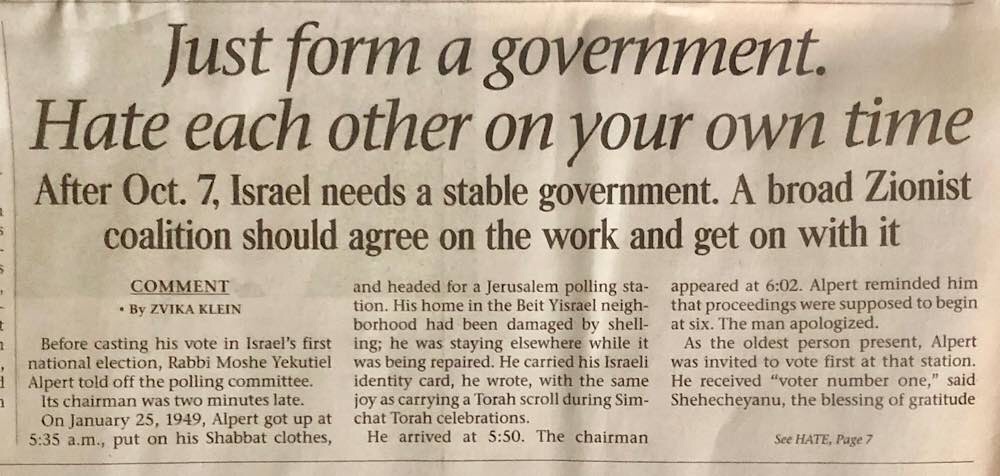
Source:
Jerusalem Post, 27 October 2026 pg 1.
Share the post "How the Israeli Vote system functions today"